Studio Note 1: Printmaking as Discovery.
I've been dabbling with printmaking for a few years now, beginning with a DIY gel plate. My process was simple: during Zoom drawing sessions I wanted to preserve the artefacts left behind by successive gestural drawings. Normally a pose is drawn, the paper wiped clean, and the next drawing begins on the same sheet. By the end of a session, a dozen drawings may have briefly occupied that surface before disappearing. Instead of wiping the paper clean, I began pressing each drawing onto a gel plate between poses, allowing those fleeting images to accumulate. The gel plate grabs and holds the charcoal marvellously well, lifting the drawing from the paper. Roll some acrylic over the plate and voilà, the resulting print becomes an archaeology of the session.
Recently, I started working on acrylic plates during sessions with etching ink and various tools, mostly fingers. So much mess, so much fun! It makes a session much more chaotic, ending up with a production line of acrylic plates and dampened paper ready to pull prints during the model breaks. I can already see that's a long learning curve ahead, but it got me thinking about the ease of gel plate monoprints again, and the possibility of offering collectors a small edition alongside the unique, original drawing.
I'd thought the problem was always going to be running to the copy shop with my artwork every time I needed a laser print copy of a drawing, but I managed to pick up a second-hand office copier, and today's experiment was transferring laser photocopies onto a homemade gel plate.
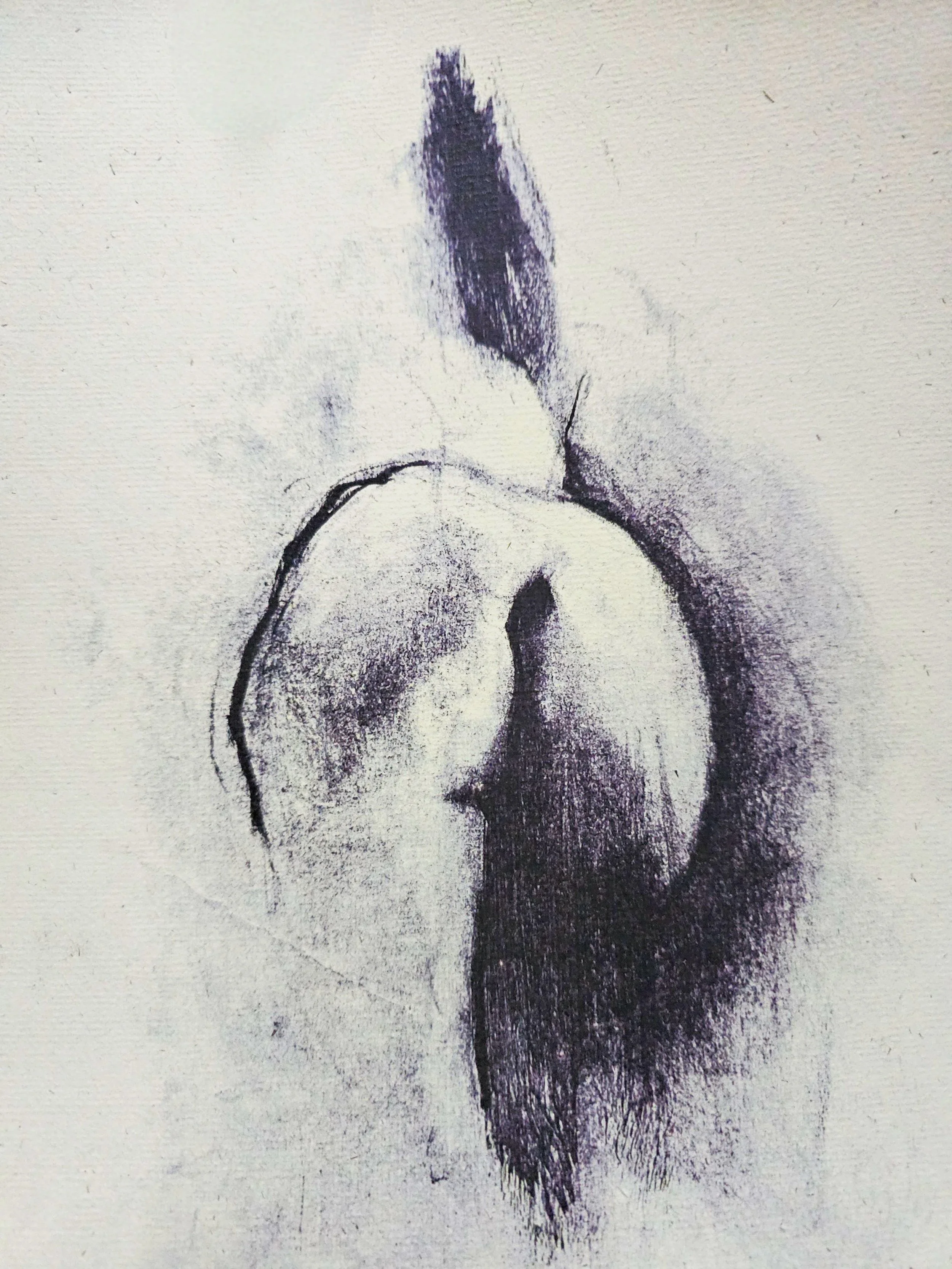
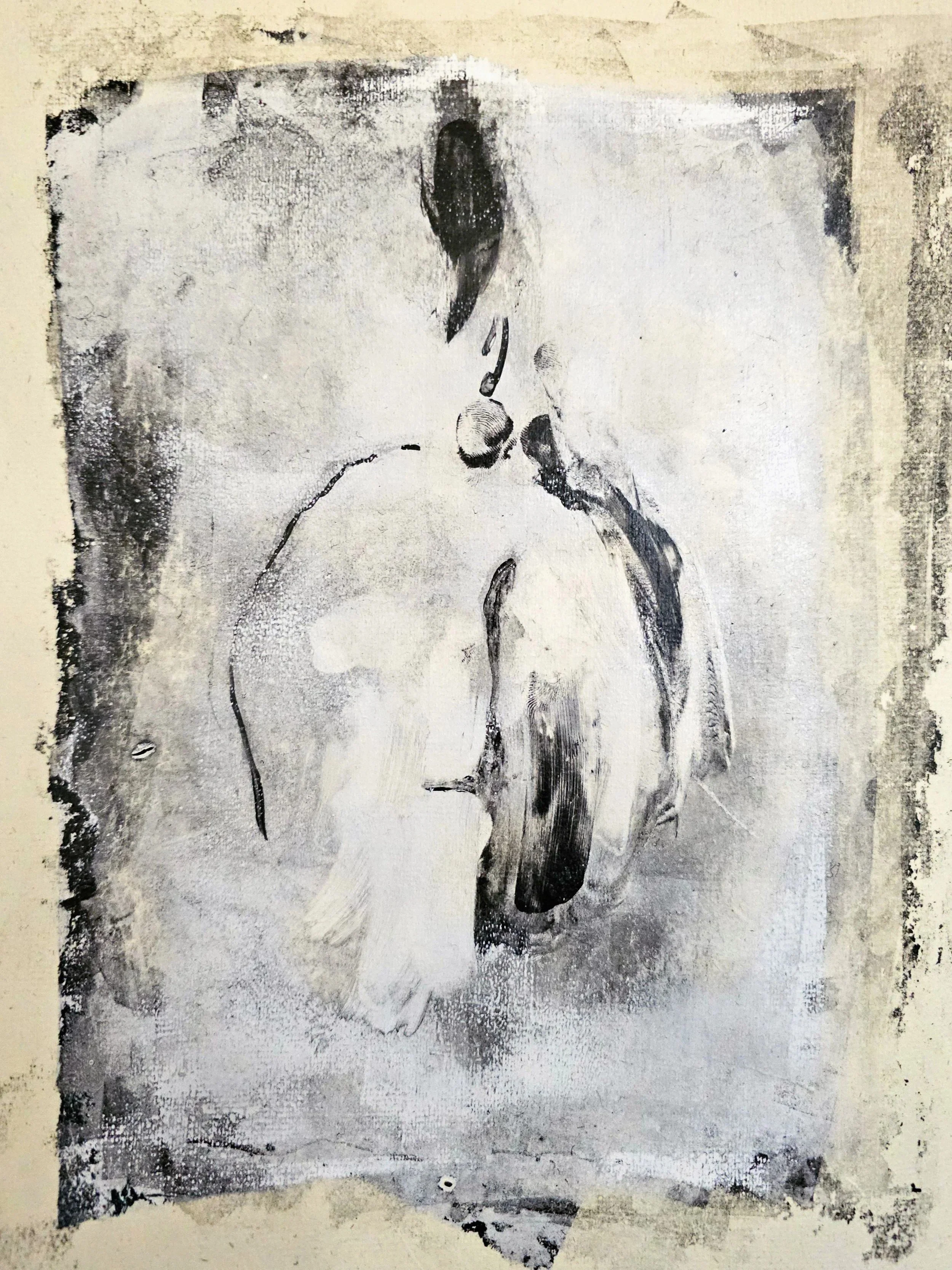
Toner resist transfers onto the gel plate have been woefully faint and patchy. I probably would have scored the process 0/10 if the notion of incompleteness hadn't become the very thing I build my drawings around. But rather than discarding yet another faint trace of toner in the resist pull, I began responding to it like I would a drawing on the easel, using my fingers to soften areas and a fine brush to toughen up some lines, before pulling the print from the gel plate.
The finished print isn't a copy of the drawing, but it’s also not the monotype I’d set out to make, which feels important.
It is a negotiation between four processes:
a charcoal drawing,
an electrophotographic matrix,
a gel transfer,
and a second act of drawing.
For a long time I’ve thought about charcoal as an archaeological material. My drawings accumulate previous gestures, erased figures, charcoal dust, fingerprints, traces left by kneadable erasers and even the odd silicone fidget toy that has found its way into my studio as a lifting tool. The drawings have never been clean. They have always carried evidence of their own making.
The gel plate extends that notion. The incomplete transfer becomes another layer. The print remembers the drawing, but it also remembers the transfer. It remembers the places where the image disappeared, inviting my fingers or brush back into the drawing.
I am loving the process of translation. Charcoal into toner, toner into a gel plate, and finally into another iteration of the drawing. The pose breathes. Each material leaves an accent. Nothing actually disappears.
The idea wasn't just to stop wiping unresolved drawings away. Most of those drawings were never meant to survive, existing only for the length of the pose. A sheet of paper only has so much life in it before the tooth is gone and it no longer wants to be drawn on. Printmaking becomes a way of giving that exhausted sheet another life.
I have no interest in making reproductions but that possibility had occurred to me alongside the printmaking experiments. Some images are unexpectedly strong as laser prints. Not as reproductions but as another material expression of the same image. And the test prints look great - different - on Hahnemühle Bugra paper.
This is all changing how I think about the drawing itself, no longer tied forever to the sheet of paper on which it was first made, and that thought has quietly begun to influence another project.
For months I have been developing work for a proposed residency, asking whether figurative drawing can perform the same psychological work as architecture.
Lately I have been wondering what happens if drawing itself becomes architectural through material.
For now, I'm still standing in my studio with a homemade gel plate, a second-hand Kyocera photocopier, and a print that refused to fail.
Sometimes the material has better ideas than the artist.
