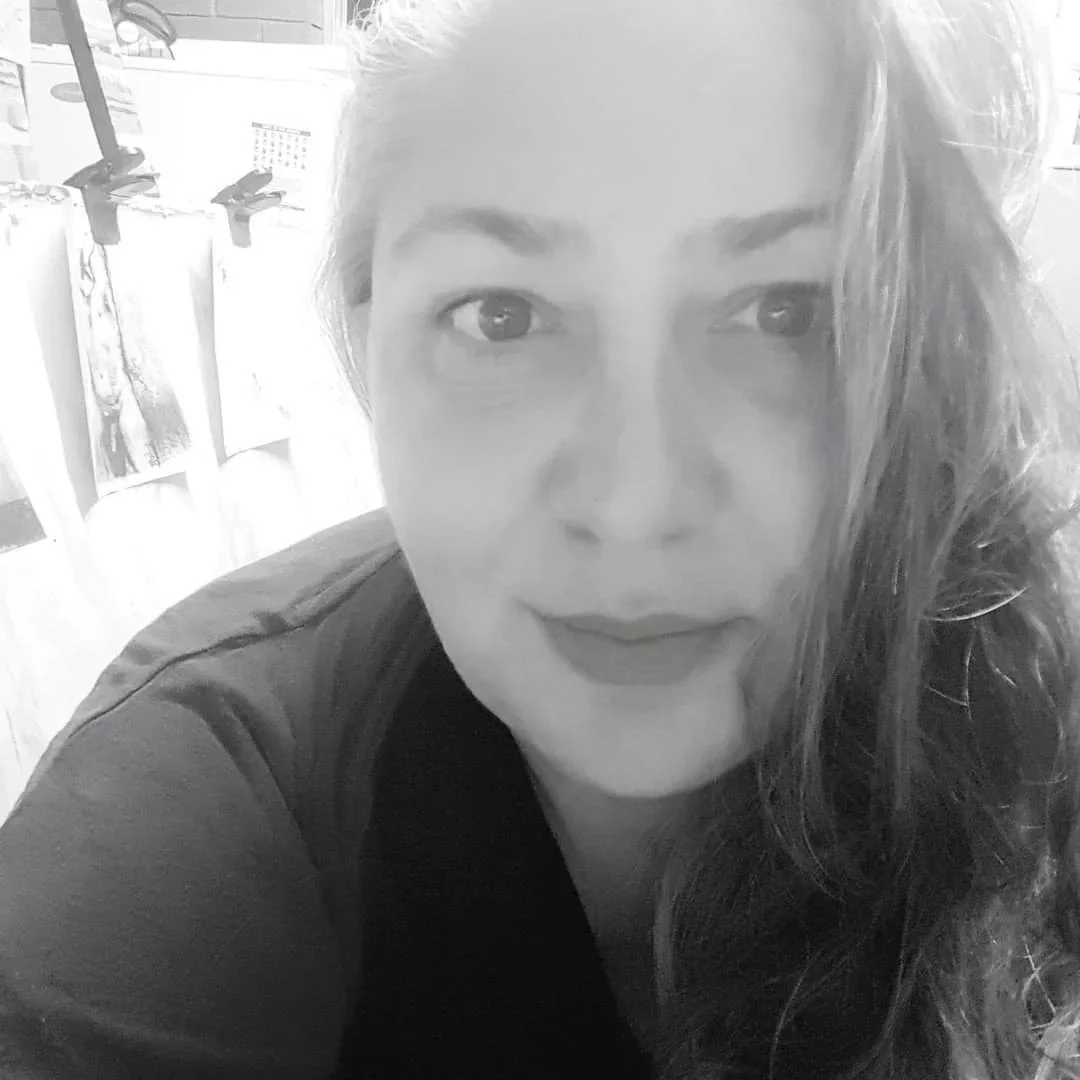
It begins with the figure.
For me the compulsion is the question. Drawing is how I think through an inquiry I didn't know I was asking.
Working primarily in charcoal on paper, I am interested in what survives: the marks that resist erasure, the spaces where form begins to dissolve, and the point at which a figure becomes the residue of sustained attention.
Figures emerge through accumulation and erosion, carrying the archaeological traces of earlier gestures.
Since 2020, this practice has developed through long-term online collaboration with life models around the world. Drawing across time zones and distance has fundamentally changed how I think about presence. Rather than treating separation as a limitation, I have come to see it as a condition that reveals how attention, trust, and perception persist across geography and mediated encounter.
Charcoal is central to my practice. It’s intimate and endlessly responsive. Every stick has its own character. I come to know them by touch.
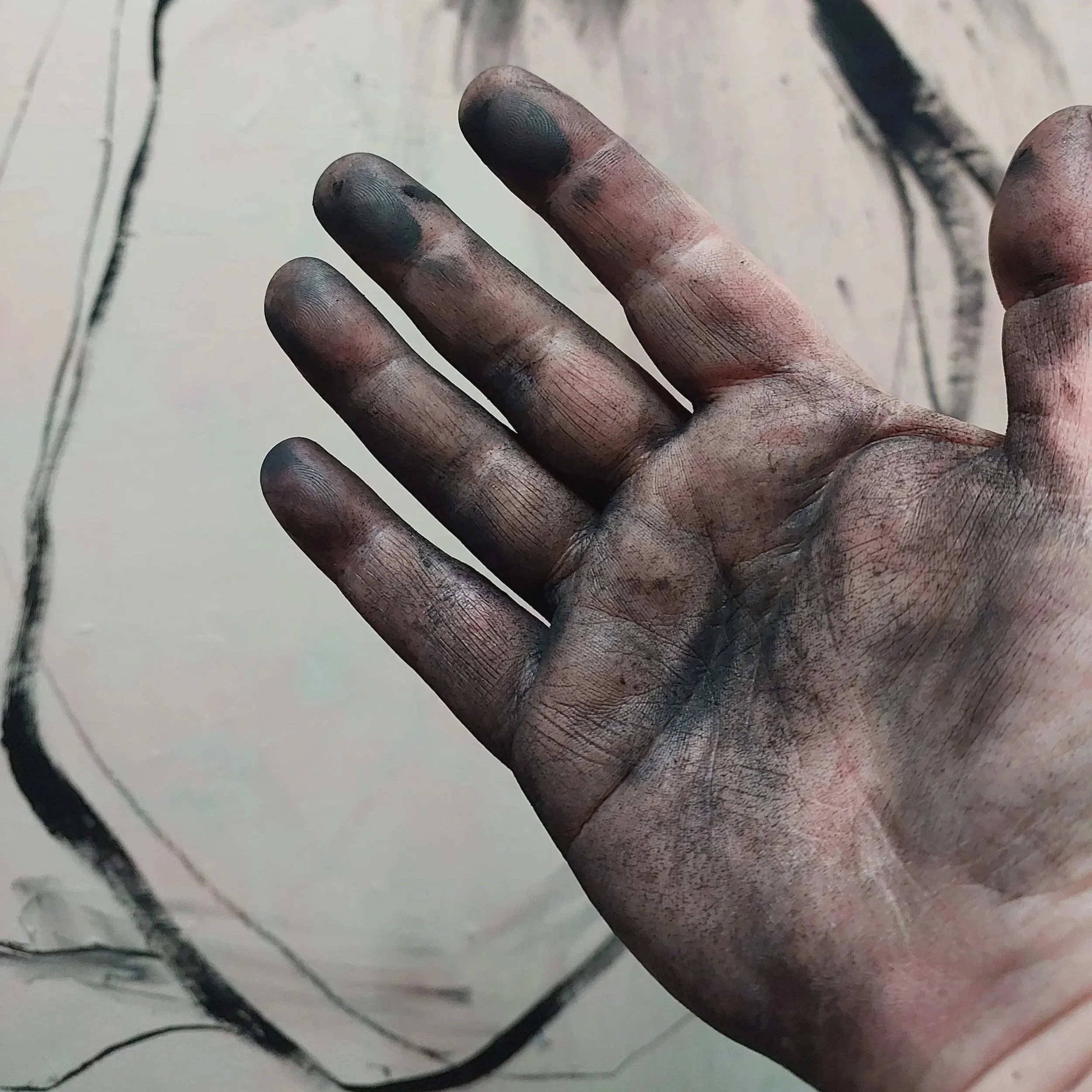
By the end of a session my hands are black. There is usually a smudge somewhere on my face or shirt, and fingerprints find their way onto door handles and teacups. Drawing doesn't stop at the edge of the paper.
The sinew of Brett Whiteley's figurative line, the landscape observation of John Olsen, and the leftovers of studying archaeology at university continue to shape my thinking.
My current work extends these ideas through an emerging inquiry into the body and sacred architecture, exploring how each drawing might accumulate memory and function as a threshold, performing the psychological movement of sacred architecture.
-
2026 SAM Open, Shepparton Art Museum
2024 Book of Days The Foundry Arts Space
2023 60BYSIXTY RED Gallery
2022 Energy of Ghosts The Foundry Arts Space
2021 Five Years Cohuna Art Gallery
-
-
-
I work with a remarkable global community of professional art models whose skill extends far beyond holding a pose. Their knowledge of gesture, expression, movement, and communication shapes every drawing.
These collaborations are founded on mutual respect, fair working practices, and a shared commitment to excellence in figurative art.
Where possible, I've included each model's Instagram handle in the artwork description so you can explore their work and support their practice. -
Drawing from life creates a different kind of attention. Working in the presence of another person allows me to respond to subtle shifts in posture, breath, weight, and gesture that a photograph cannot fully capture.
The relationship between artist and model is an important part of my practice. It brings an immediacy, empathy, and sense of shared presence that becomes embedded in the drawing itself.
Many of the models I work with are also talented self-portrait photographers, and I encourage you to explore their work. Photography and drawing are different languages, each with their own strengths. For me, the experience of drawing from life remains at the heart of my practice.
Where possible, you'll find each model's Instagram handle listed on the artwork's page so you can discover more of their work.
-
At this time, I am closed to commissions.
-
-
They are finished, but reflect the circumstances of their making: a few-minute gesture, a movement pose, or a sustained study. And if I'm listening to the drawing, not all drawings ask to be evolved.
For me, a drawing is not a record of every visible detail but an exploration of presence. I am less interested in describing the body than in discovering it. Erased, fragmented, and unresolved passages are an invitation to the viewer to complete the image through their own perception.
-
I work with willow charcoal sticks and make my own powder, sauce, and glazes from their remnants and broken bits, developing bespoke drawing materials through experimentation in the studio.
For other works, I use professional artist-quality materials from trusted manufacturers, supporting Australian-made products wherever possible.Some of my favourite materials include a selected palette of Art Spectrum Extra Soft, Unison and Diane Townsend pastels, and Langridge and Derivan Matisse paints and mediums.
I typically use papers milled by Strathmore or Fabriano alongside Arches BFK Rives and my special stash of Hahnemühle Bugra for larger works.
The materials I choose are intended to ensure the longevity and archival quality of each artwork.
I prefer casein fixatives.
I also enjoy collecting traditional drawing materials and pigments. Australian ochres and charcoal from memorable campfires connect my work to the landscape I call home. Recently, I brought back sanguine and pietra nera from Italy. These materials have become part of my studio and occasionally find their way into particular artworks. -
I live and work in a beautiful part of Australia.
Northern Victoria is home. -
When available, you will find works for purchase on the Available Works page.
-
Yes. All of my artworks are original, whether created on paper or canvas.
Occasionally I produce limited edition monotypes or chine collé prints. These editions are strictly limited to 10 impressions. The edition number will be clearly marked on the artwork and recorded on its Certificate of Authenticity.
-
Yes. Every original artwork is supplied with a signed Certificate of Authenticity (COA).
The certificate includes the artwork's details along with my signature to verify its authenticity.
I recommend placing the COA behind the artwork when framing, so it remains with the piece and is less likely to become separated from it over time.
-
Lay-by Terms
Lay-by is available on artworks over $500 AUD.
A 25% non-refundable deposit is required to secure the artwork.
The remaining balance is payable over up to 8 weeks by instalments.
Payments may be made weekly, fortnightly or monthly.
The artwork remains the property of the artist until paid in full.
Once the final payment has been received, the artwork will be carefully packed and shipped, or made available for collection.
If payments stop and no contact is made for 30 days, the lay-by may be cancelled. Payments already made (excluding shipping) will be retained as a cancellation fee, and the artwork will be returned to sale.
If you need a little extra time, please get in touch. I'm always happy to discuss a payment plan before the lay-by expires.
-
It depends on the finish I have chosen for your specific piece.
Generally, each charcoal or pastel drawing is lightly fixed unless otherwise stated. While this helps minimise smudging, charcoal and pastel remain delicate media and should be handled with care.Museum conservators often wear thin cotton gloves when handling works on paper. An easy alternative is to fold two small pieces of clean paper and place one over each edge of the artwork where you hold it, using them as protective handles. This helps prevent accidental fingerprints from reaching the surface.
I recommend leaving the artwork in its protective glassine sleeve until it is professionally framed to minimise the risk of accidental damage.
For the longevity of your artwork, avoid hanging it in direct sunlight or areas of high humidity. You'll know the humidity is too high if the paper begins to buckle. Works on paper should be framed using archival-quality materials and UV-protective glazing.
Some surfaces, like board mounted drawings may have a cold wax finish which cures over time. These pieces are more durable and do not need to be framed under glass. However, care should be taken not to touch the surface. These pieces require weekly, gentle dusting to keep them looking fresh.
Encaustic wax contains beeswax and resins which may “bloom” if hung in direct sunlight or high temperatures. Bloom can be buffed with a soft, lint free cloth.
Paintings are finished with varnish or wax and a regular light dusting is appropriate.
In all cases prolonged hanging in direct sunlight will damage your artwork and caution is recommended. -
Unless otherwise stated, artworks are sold unframed. This allows you to work with your local picture framer to select a frame that best suits your home and personal style.
From time to time, I also offer small float-framed canvases, encaustic works, and mounted works on paper. These will be clearly identified in the artwork description.
-
Most of my works on paper are in the A4 to A3 size range. These works are wrapped in a glassine sleeve and packed flat for postage.
Larger works are rolled in glassine and mailed in a tube.
Small paintings are mailed in a protective box.
Larger canvases will be removed from the stretcher and packed as a roll unless otherwise arranged via appropriate courier services by the buyer.
All work is shipped via Australia Post. -
Please choose carefully, as I do not accept returns or exchanges for change of mind.
If your artwork arrives damaged, or you believe there is an issue with the artwork, please contact me within 7 days of delivery. Include photographs of the packaging prior to opening so I can assess the issue and arrange an appropriate resolution.
I take great care to accurately describe and photograph every artwork. Please note that colours may vary slightly between screens and devices.
The natural characteristics of handmade papers and traditional drawing materials, including charcoal and pastel, form part of the artwork and are not considered faults.
-
You're very welcome to share photographs of your artwork in its new home on social media. If you do, I'd love it if you tagged me.
Purchasing an original artwork does not transfer copyright. Copyright remains with the artist. Except as permitted by law or with the artist's written permission, the artwork, including images of the artwork, may not be reproduced, copied, shared, published, or used for commercial purposes.
If you would like to reproduce an image of my work in a publication, exhibition catalogue, educational resource, editorial feature, or commercial project, please get in touch. I'm happy to discuss licensing on a case-by-case basis.
-
I share new work, works in progress and exhibition news on Instagram.
When original work is available to purchase, it will be listed on the Available Work page.
If you'd like to hear directly about available work, please use the contact form and I'll add you to my collector's list.
-
I strictly create and sell original, physical artwork. I do not participate in the cryptocurrency or NFT marketplace, and I will not and have not ever authorised my work to be minted or sold digitally. I never will. I don't even engage in the digital print market.
I do not support AI manipulation or regurgitation of my artworks either. I consider these activities to be an ethical violation of my artistry as a figurative artist and the living models I work with and, quite frankly, the antithesis of creativity. I am not a willing participant to your get rich quick scheme. Jesus Christ, people make an actual effort to do good things with your time.
All inquiries regarding NFTs or digital minting are automatically filtered, unread, and permanently deleted.
-
I respect your privacy as much as I respect my own.
Your information is used only to:
process and fulfil artwork purchases
arrange shipping and delivery
respond to enquiries
keep records of artwork sales and correspondence where necessary
I won't use your information for any other purpose.
Payments made through this website are securely processed by Squarespace and its payment providers. I do not see or store your full credit card or payment details. Please refer to the privacy policies of the relevant payment provider for information about how your payment information is handled.
If you subscribe to receive updates, you'll only receive occasional emails about availability of work or exhibitions. You can subscribe/unsubscribe at any time using the contact form.
I do not sell, rent, or trade your personal information.
Your information is only shared when necessary to provide services you've requested, such as payment processing, shipping artwork, or where required by law.
This website is hosted by Squarespace, which may use cookies and similar technologies to help the website function, analyse traffic, and improve your experience. You can control cookies through your browser settings.
If you'd like to access, update, or request deletion of your personal information, please get in touch through the Contact page.
This Privacy Policy may be updated from time to time. Any changes will be published on this page.
Everything you wanted to ask, and a few things you probably didn't.
FAQs
Everyone is interesting if you ask the right questions.
Please note: I only sell original physical artwork. I do not sell digital files, prints, or NFTs. All digital or NFT-related solicitations are auto deleted.